

Understanding parking signs: the global challenge
Parking signs can be one of the most confusing aspects of driving, regardless of which country you are in. While a “P” generally suggests you can park, the rules surrounding that permission vary wildly across borders. Misinterpreting a sign can lead to hefty fines, towing, or clamping. The confusion often stems from the fact that while some symbols are universal, the “fine print”—time limits, specific days, and exceptions—changes depending on the region.
Avoid misunderstandings by always reading the supplementary plates, checking road markings, and identifying whether you are on private or public land. With a digital parking solution like OPARKO, the guesswork is removed. Digital management offers easy administration, access control, and maximum utilization of spaces without the need to decode complex physical signage.
Navigating the maze of parking signs
A guide to the complexity of parking restrictions and why digital solutions are the future.
Parking signs and their supplementary text can confuse even the most experienced drivers. A misinterpreted arrow or a missed time restriction can cost time and money. Whether you are a property owner, a city planner, or a driver, understanding the complexity of these signs is key to maintaining order and avoiding conflict.
At OPARKO, we tailor digital parking solutions where central administration and intuitive control make it easy to manage parking rules, removing the ambiguity of physical signs.
Why parking signs are so complex
Parking signs serve a vital purpose: they regulate traffic flow, ensure safety, and allocate limited space. However, the design philosophy differs globally. In Europe and Australia, you look for symbols (like the Blue “P”). In North America, you often look for text-based instructions (Green for allowed, Red for prohibited).
The challenge isn’t the main sign; it is the layers of exceptions added over time. Understanding these layers helps you avoid unnecessary expenses and ensures you are respecting local regulations.
Common themes in global parking signage
While specific traffic laws change, the structure of parking signage follows a few common patterns that are important to recognize:
The main indicator (allowed parking)
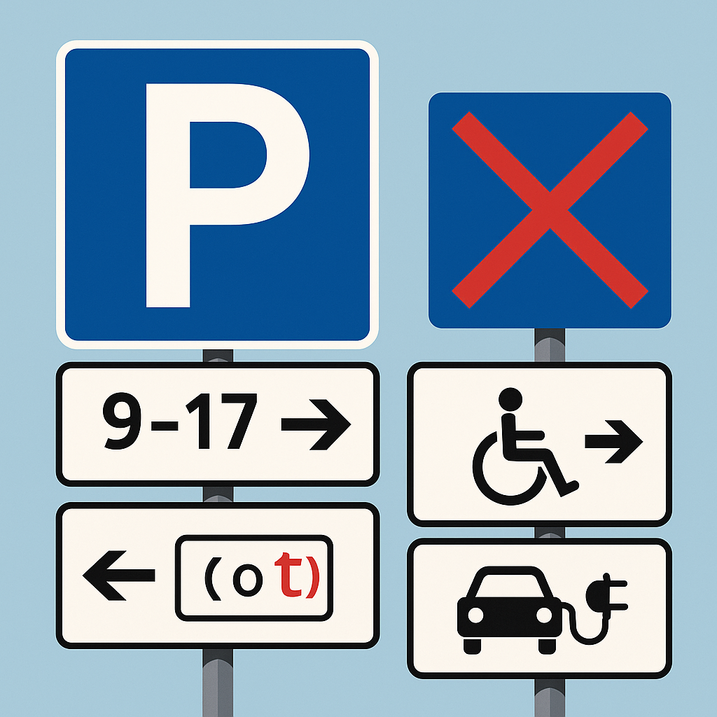
In most of the world (including the UK and Europe), a Blue Square with a White “P” indicates an allowed parking area. However, in the US and Canada, this is often represented by a white rectangular sign with green text (e.g., “2 Hour Parking”). If this sign stands alone, it usually means parking is allowed indefinitely, but this is rare in urban areas.
The “arrow” confusion
One of the biggest sources of fines for international drivers is the direction of arrows:
- In some regions, an arrow pointing UP means the zone starts here and continues forward.
- In others (like the US and UK), arrows often point Left or Right to indicate which side of the pole the rule applies to.
- Misinterpreting an arrow often leads to parking just outside the legal zone.
Supplementary plates: the fine print
The main sign tells you what you can do; the supplementary plate (the smaller sign underneath) tells you when. This is where most mistakes happen.
Time limits and exceptions
Supplementary plates specify the “Active Hours.” For example, “Mon-Fri 9am-6pm.” The syntax for these days varies significantly:
- Explicit Text: Many countries write out “Mon-Fri” or “School Days Only.”
- Color Codes: Some European countries use specific colors to denote weekdays vs. weekends/holidays (e.g., black for weekdays, red for Sundays).
- Permit Only: Signs stating “Permit Holders Only” or “Residents Only” mean you cannot park there without a registered vehicle.
Because these rules are so difficult to standardize physically, OPARKO’s digital platform is a game-changer. It allows administrators to manage who can park and when, without relying on drivers to correctly interpret complex physical calendars on a sign.
Prohibitions: lines vs. signs
Knowing where not to park is just as important. The visual language for “No Parking” differs drastically:
- Symbols: A Blue circle with a Red border and a diagonal line (Europe/UK) usually means “No Parking.” A clear Red circle or a “No Stopping” text sign means you cannot stop at all.
- Road Markings: In the UK, double yellow lines mean no parking. In the US, a red curb often indicates a fire lane (no stopping), while a yellow curb indicates a loading zone.
Special parking zones
Certain spaces are reserved for specific needs. Recognizing these symbols is universal:
- Accessible Parking: Marked with the universal wheelchair symbol. Unauthorized use almost always results in a severe fine.
- EV Charging: Marked with an electric vehicle symbol. These usually require the car to be actively charging, not just parked.
- Private Property: Signs indicating “Private Property” or listing a towing company mean the standard road rules do not apply, and enforcement is strict.
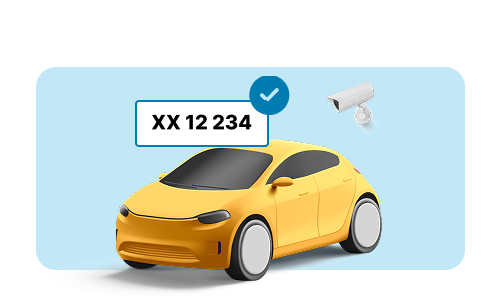
Managing these special zones requires strict oversight. OPARKO’s system ensures that only valid permit holders or actively charging EVs utilize these premium spaces, using tools like Automatic Number Plate Recognition (ANPR).
Visibility and enforcement
For a parking rule to be enforceable, the sign must be visible, reflective, and well-maintained. If a sign is faded or hidden by a tree, the validity of a fine can often be challenged. However, relying on physical signs is becoming outdated.
With OPARKO, enforcement moves from physical patrols looking at stickers to digital scanning of license plates, ensuring 100% accuracy regardless of the physical sign’s condition.
Best practices for drivers and property owners
- Read the entire sign: Never stop at the big “P”. The rules are in the small print below.
- Check for lines: Colored curbs or lines on the road often override vertical signs.
- Respect Private Property: Private lots often require digital registration (via apps or tablets inside the building).
- Go Digital: If you manage a lot, stop relying on stickers and physical permits.
With central digital solutions from OPARKO, property owners can secure easy access control and eliminate the confusion of physical signage.
Frequently asked questions
Why do rules vary so much between countries?
Parking laws are developed locally over decades. While there are attempts to standardize (like the Vienna Convention), local nuances regarding holidays and street layouts remain.
Do I always need a physical permit?
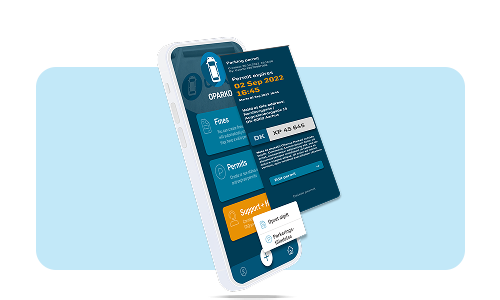
Increasingly, no. Modern systems like OPARKO use your license plate as your permit. However, in older systems, you may still need to display a physical ticket or disc.
What is the difference between “No Parking” and “No Stopping”?
“No Parking” usually allows you to stop briefly to drop off a passenger or load goods. “No Stopping” means your wheels cannot stop moving in that zone for any reason other than traffic.
Simplify parking with digital overview
With OPARKO, you get a digital parking solution that not only helps drivers navigate rules but makes it effortless for administrators to manage the entire parking area from one interface.
Whether you manage a residential complex, commercial property, or hotel, you get:
- Central platform for permits, enforcement, and payments
- Automatic ANPR (license plate recognition)
- Digital guest and resident permit handling (no more physical passes)
- Maximum utilization of your parking assets
The result? Less administration, fewer misunderstandings, and a better experience for users.
Ready to make parking smarter?
OPARKO’s solutions are tailored for property managers and owners who want efficient control and potential revenue without the hassle of complex physical infrastructure.
Visit oparko.com and discover how digital parking management makes a difference.
Understanding parking signs is good. Eliminating the confusion with OPARKO is better.