

A guide to parking discs for expats and travelers: Denmark vs. the world
For millions of drivers in Denmark, the parking disc—known locally as the p-skive—is a standard part of daily driving. However, for international residents, expats, and tourists, this little blue clock is often a source of confusion and unexpected fines. In this guide, we provide a complete overview of how the system works, specifically tailored for those used to driving in the UK, US, Australia, or other parts of Europe.
At OPARKO, we offer digital parking solutions that simplify time-limited parking, ensuring a smooth experience for international tenants and guests—eliminating the confusion of physical discs.
What is a parking disc? (For US, Canadian, and Australian drivers)
If you are visiting from North America or Australia, the concept of a parking disc is likely foreign to you. In your home countries, time-limited parking is usually enforced by parking meters, “Pay & Display” tickets, or tire chalking.
In Denmark, the rules are different:
- Do not look for a meter: If you see a sign with a time limit (e.g., “2 Timer” or “30 min”), but no ticket machine, parking is free—but only if you display your arrival time.
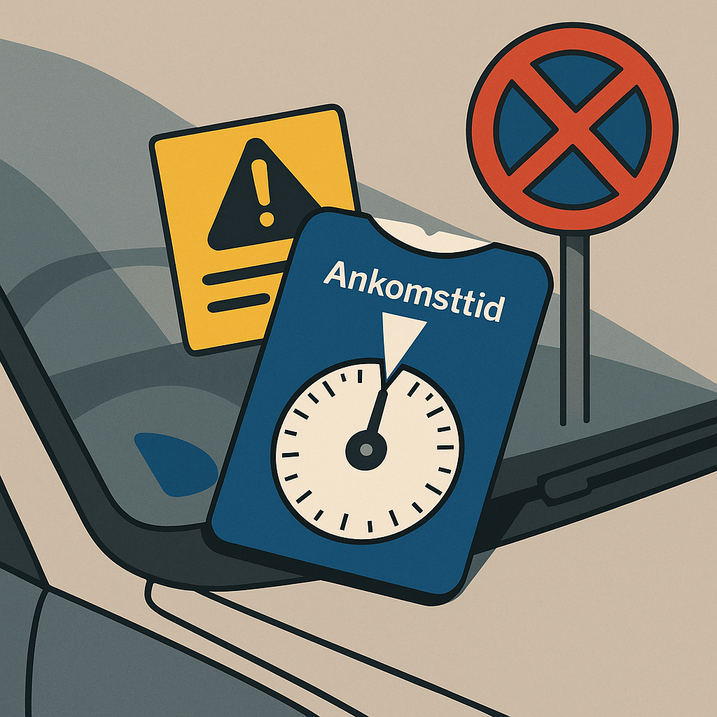
- The device: You must use a parking disc (a plastic or paper clock) placed on the dashboard or attached to the windshield to indicate when you parked.
- The risk: Failing to display this clock results in a fine, even if you haven’t exceeded the time limit.
The Danish rule: Round up to the nearest quarter-hour
This is the most critical rule for international drivers to understand, as it differs from neighboring countries.
In Denmark, you must set the arrow on the disc to the nearest quarter-hour in the future relative to your arrival time.
Examples:
- If you arrive at 14:03, set the disc to 14:15.
- If you arrive at 14:16, set the disc to 14:30.
Warning for German and UK Drivers:
- vs. Germany: In Germany, you typically round up to the next half-hour. If you do this in Denmark (e.g., setting it to 14:30 when you arrived at 14:03), you may be fined for setting the time too far ahead.
- vs. UK: In many UK council zones, you set the disc to your exact arrival time. In Denmark, you must use the quarter-hour interval.
The “blue badge” confusion (for UK drivers)
Drivers from the UK often associate a “Blue Badge” exclusively with disability parking permits. It is vital to understand the difference when driving in Denmark and the wider EU:
- The Standard Disc: The general parking disc in Denmark is a blue square. This is for everyone and does not grant you the right to park in disabled bays.
- Disability Permits: If you require disabled parking, you must display your official disabled parking badge (which is recognized across the EU/EEA), not just the standard parking time disc.
Manual vs. electronic discs
Rental Cars: Most modern Danish rental cars come equipped with an electronic parking disc attached to the bottom right of the windshield. These automatically detect when the engine stops and set the time for you. You generally do not need to touch these.
Private or Foreign Cars: If you bring your own car from abroad, or buy an older car in Denmark, you must buy a manual disc at a gas station or auto shop. You are responsible for manually setting the hands of the clock every time you park.
Common mistakes to avoid
Most fines issued to internationals happen due to simple misunderstandings. Avoid these common pitfalls:
- Forgetting the disc: Assuming parking is free because there is no payment machine.
- “Rewinding” the time: You generally cannot go back to your car to move the dial forward to get “extra time” without moving the car.
- Poor visibility: Leaving the disc on the seat or floor instead of the dashboard.
- Using the wrong logic: Applying German (half-hour) or UK (exact time) rules in Denmark.
Modern parking management for international tenants
Managing property with a diverse group of residents or international employees can be challenging when relying on physical discs and complex signage.
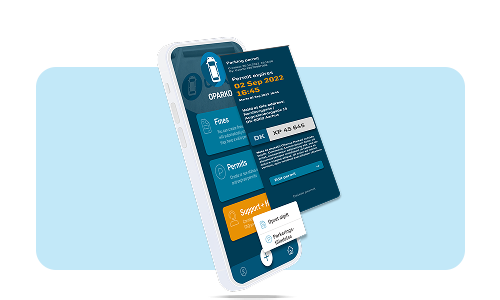
OPARKO offers digital parking platforms that modernize this process:
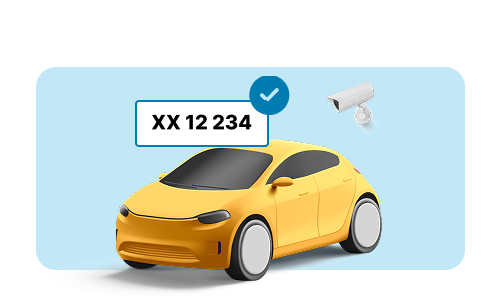
- No more discs: We use Automatic Number Plate Recognition (ANPR) or digital permits.
- Simplicity for expats: International tenants don’t need to learn complex local rules; their license plate acts as their permit.
- Automated administration: Property managers can handle permissions online without distributing physical passes.
Frequently asked questions
Can I use my Danish electronic disc in other countries?
It depends. While approved in Denmark, electronic discs are not accepted in every European country. Always check local regulations before crossing a border.
If I arrive at 14:00 exactly, how do I set it?
If you arrive exactly on the hour or quarter-hour, you set it to that specific time (14:00).
Can I just move my car to the next parking bay to restart the time?
Technically, no. In many zones, “reshuffling” your car within the same immediate area to extend time is prohibited. You usually need to leave the zone entirely.
Conclusion
While the parking disc system is efficient once understood, it requires a change of habit for drivers from the US, Australia, and the UK. Remember to set the time to the immediate next quarter-hour, check for the blue signs, and if you are managing a building, consider switching to a digital solution.
At OPARKO, we help landlords and companies bridge the gap with digital parking management that works for everyone, regardless of where they earned their driver’s license. Contact us today to learn more.