

Will self-driving cars change how we think about parking?
Yes, self-driving cars are revolutionizing the industry by making parking fully automated, creating a need for smarter, more space-efficient, and eco-friendly solutions. Autonomous Valet Parking (AVP) eliminates the need for wide ramps and maneuvering space, enabling a complete rethinking of parking garage design. At the same time, digital management and automated systems create a more efficient user experience and higher capacity utilization. Urban planning and legislation—such as the UK’s Automated Vehicles Act and US SAE Level 4 standards—are adapting to support this infrastructure. Platform-based solutions like oparko are paving the way for a flexible, sustainable, and future-proof parking ecosystem.
We are on the threshold of a transport revolution where self-driving cars are not just changing how we move, but also how we park. Autonomous vehicles have already demonstrated their potential, and this technological evolution affects the practical, architectural, and environmental dimensions of parking. For Residential Management Companies (RMCs), commercial real estate developers, and businesses, this presents entirely new opportunities for smarter and more efficient facility management.
Autonomous valet parking (AVP) – when the car parks itself
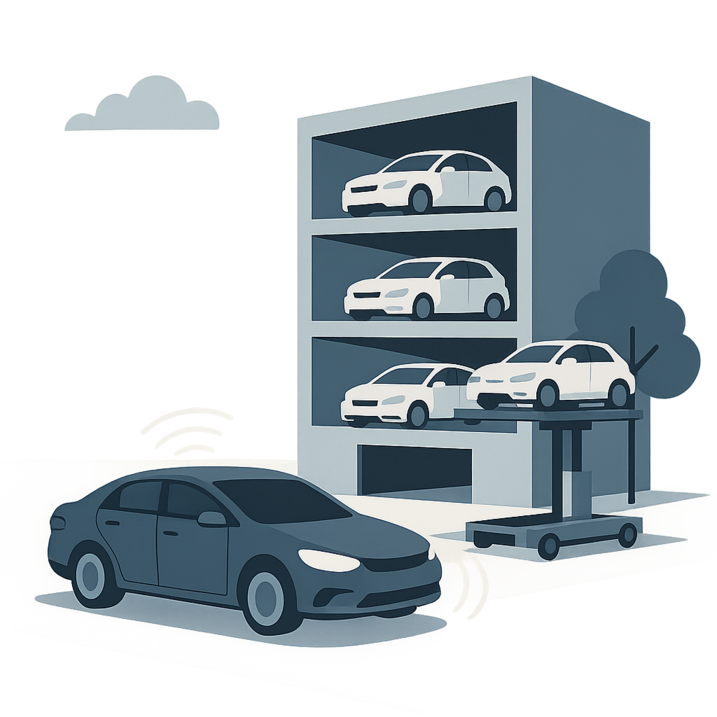
Modern technology now allows vehicles to park without a driver. Leading manufacturers like Mercedes-Benz and Bosch have already set the global benchmark at Stuttgart Airport, demonstrating systems where the car finds an available spot and maneuvers into it using sensor-based navigation. This is known as Autonomous Valet Parking (AVP)—a key feature in the universe of self-driving cars.
- The driver simply stops at a designated Drop-off zone, and the car parks itself.
- Unnecessary driving in search of a spot is eliminated.
- Improved traffic flow in cities and facilities.
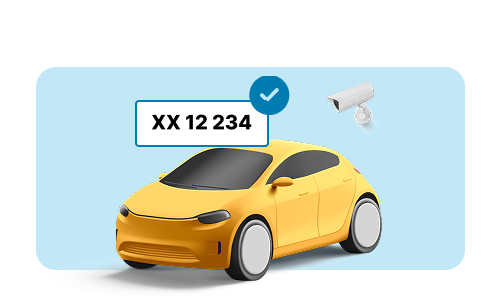
- Automated access and payment via ANPR (Automatic Number Plate Recognition) or LPR (License Plate Recognition).
Rethinking future parking infrastructure
When cars park themselves, the need for wide lanes and pedestrian safety zones inside the parking area diminishes. This opens up entirely new design principles for future facilities. Adhering to international standards like ISO 23374, facilities can feature tighter spacing between cars, fewer ramps, and simpler traffic flow, allowing for significantly better use of square footage. Combined with digital management platforms, capacity and revenue can be increased significantly.
We are already seeing trends where parking garages are becoming multifunctional mobility hubs—integrated with EV charging stations, last-mile logistics, and commercial facilities. Here, sustainable operation and digitization play a central role. oparko delivers modern solutions for this specific purpose, where the entire parking infrastructure is managed via one central platform—focusing on flexibility, environmental impact, and economics.
Smarter and greener parking ecosystems
When autonomous vehicles park themselves without human error or inefficiency, it reduces not only traffic congestion but also CO₂ emissions by eliminating the costly search for a spot. Integrated solutions with smart charging, camera surveillance, and automated control ensure benefits for both the environment and users.
Oparko supports this development by offering scalable parking solutions where automation and data-driven decision-making minimize wasted time and maximize the utilization of existing spaces. Through user-friendly systems and app-based management, property managers can easily adapt solutions to changing needs—whether for residents, guests, or commercial tenants.
New user experiences and flexibility
The future of parking is autonomous—and user-friendly. As technology improves, drivers will be able to send their cars to park, charge, and return via an app. This changes not only daily routines but user experience on a large scale.
Especially in complex infrastructures like shopping centers, residential developments, and airports, digital parking operations will remove barriers such as wasted time and confusion. oparko’s central platform ensures that everything from permissions and payments to enforcement runs automatically and reliably—benefiting both users and owners.
Adjustments in urban planning and legislation
Autonomous vehicles require infrastructure and legislation to adapt accordingly. Many cities are moving toward “Curbside Management,” transforming static street parking into dynamic Pick-up/Drop-off (PUDO) zones to prioritize traffic flow and accessibility. Simultaneously, intelligent traffic management strategies are needed to prevent empty autonomous vehicles from circling aimlessly.
Globally, legal frameworks are evolving rapidly. From the Automated Vehicles Act 2024 in the UK to NHTSA guidelines in the US and Level 4 approvals in Germany, the path is being cleared. With oparko’s digital parking solution, developers and decision-makers can already take the step toward future-proof parking. The solution is scalable, user-friendly, and tailored—whether for retail, office buildings, or residential complexes.
Conclusion: more than just parking
Self-driving cars are not just changing the way we park—they are changing our entire view of parking as a function and as infrastructure. Future facilities will be intelligent and multifunctional, with digital control and a focus on sustainability.
At oparko, we believe that digital parking solutions are the key to supporting this transformation. With a central platform, effective enforcement functions, and full automation, we create not just order out of chaos, but also increased revenue and a greener approach to mobility. It is time to think of parking as a strategic and dynamic part of the urban future—not just static vehicle storage.