

The international driver’s guide to parking in Denmark: How to avoid fines
TL;DR
- The “P-disc” is mandatory: In time-limited free zones, you must use a parking disc (P-skive) set to the next quarter-hour after arrival.
- The 10-meter rule: You cannot park within 10 meters (approx. 33 feet) of an intersection, even if there are no yellow lines painted on the curb.
- Strict Bay Parking: Your entire vehicle (including bumpers) must fit inside marked lines.
- Stopping vs. Parking: Stopping is less than 3 minutes (e.g., dropping someone off). Anything longer, or leaving the vehicle, counts as parking.
- Private Parking (OPARKO): Private areas (shops, residential) often use digital cameras (ANPR). You won’t get a physical ticket; fines are sent digitally. Always check signs on private land.
Read the full guide below to understand how Danish parking culture differs from the UK, US, and other regions, and how to avoid costly mistakes.
1. The parking disc (“P-skive”): A Danish specialty
One of the biggest surprises for visitors from the UK or US is the parking disc system. While you might be used to Pay & Display machines or parking meters, many parking zones in Denmark are free but time-limited (e.g., “2 hours max”).
In these zones, you generally do not need a ticket. Instead, you must use a parking disc.
How it works:
- The Rule: You must set the clock on your disc to the next quarter-hour after your arrival.
- Example: If you park at 10:04, you set the disc to 10:15. If you park at 10:16, you set it to 10:30.
- Placement: It must be visible in the bottom right of the front windshield.
Important for Rental Cars: Most rental cars come with a disc attached to the windshield. Ensure the clock is set correctly every time you park. If you use a portable disc, make sure it is the only one visible—having two discs with different times is an instant fine.
2. The “invisible” 10-meter rule
In many countries, like the UK, “No Parking” zones near corners are clearly marked with double yellow lines. In the US, curbs are often painted red or yellow.
In Denmark, the paint is often missing, but the rule still applies.
It is illegal to stop or park within 10 meters (approx. 33 feet or two car lengths) of an intersection. This applies to the corner of the road closest to you. International drivers frequently get fined here because they look for painted lines rather than estimating the distance. If you are close to a corner, always leave a wide gap.
3. “Standsning” vs. “Parkering” (Stopping vs. parking)
Danish law makes a strict distinction between stopping and parking. Understanding this can save you a fine in “No Parking” zones versus “No Stopping” zones.
- Stopping: Bringing the vehicle to a halt for less than 3 minutes (e.g., to load luggage or pick up a passenger), provided the driver usually stays in the car.
- Parking: Any stop lasting longer than 3 minutes, OR leaving the vehicle unattended (even for 30 seconds).
Note on Idling: Environmental rules in Danish cities are strict. Idling your engine while stationary for more than 1 minute is often illegal. Do not leave the engine running to keep the AC on while parked.
4. Strict enforcement of parking bays
When parking in a marked bay, Danish enforcement is precise. In some countries, having a wheel on the line is acceptable. In Denmark, your entire vehicle (mirrors, bumpers, and tow bars included) must be inside the lines.
If your rear bumper hangs over the line into the next space or a walkway, you are technically parked illegally.
5. Private parking & digital enforcement (OPARKO)
Denmark has a mix of public city parking and private parking (e.g., supermarkets, business parks, residential lots). Private areas typically have stricter rules and higher fines.
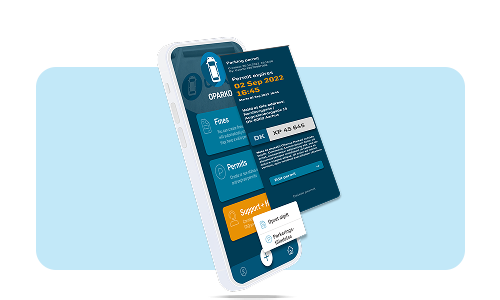
Many private operators, such as those using the OPARKO system, utilize advanced digital enforcement rather than parking attendants patrolling on foot.
What international drivers need to know about digital parking:
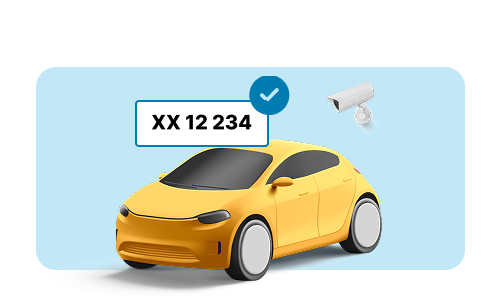
- Camera Recognition (ANPR): Cameras often scan your number plate when you enter and exit an area.
- No Paper Ticket: If you overstay your time or fail to register via an app, you might not find a physical ticket on your windshield. Instead, the fine is issued digitally.
- Rental Car Impact: If you trigger a digital fine, it will be sent to the rental agency, which will charge your credit card later (often with an added administration fee).
OPARKO’s digital platform ensures fairness by using exact data rather than human estimation, but it also means you cannot “talk your way out of a ticket” with an attendant. Always check the signage when entering a private lot to see if you need to register your license plate digitally.
6. Summary: Your survival checklist
- Check for a Disc: Does your car have a parking disc? Set it to the next quarter-hour.
- Watch the Corners: Keep 10 meters away from junctions, even if there are no lines.
- Stay in the Lines: Ensure your car fits 100% inside the markings.
- Look for Cameras: In private lots, look for signs mentioning digital control or apps.
- Don’t Idle: Turn off your engine if you are stopped for more than a minute.
This guide is based on general Danish traffic regulations and modern digital management standards used by platforms like OPARKO to ensure efficient and fair parking for everyone.