

Parking on main roads and country roads: A guide for international drivers
TL;DR: Rules for rural parking outside city zones
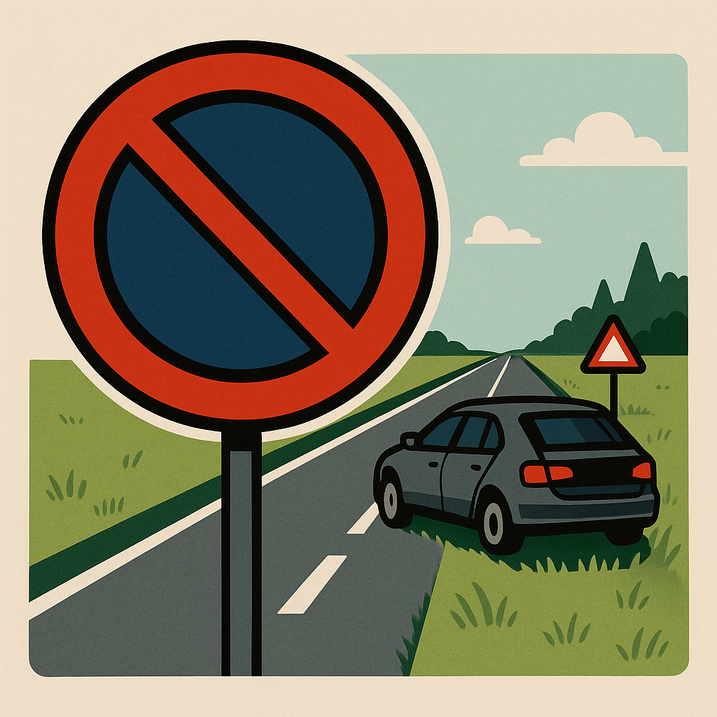
- Main Roads (Yellow Diamond Sign): Parking is prohibited. Only short stops (drop-offs) are allowed, and you must stay in the vehicle.
- Country Roads: Parking is generally allowed on the right side unless signs or solid lines indicate otherwise.
- The 3-Minute Rule: A stop longer than 3 minutes, or leaving your vehicle for any amount of time, constitutes “parking.”
- Safety Distances: Keep 10 meters (33 ft) from intersections and 12 meters (40 ft) from bus stops.
- Verges vs. Paths: You may park partially on the grass verge, but never on cycle paths or sidewalks.
- For Property Managers: Managing parking for international residents or guests can be complex. Digital solutions like OPARKO simplify permits and enforcement.
Driving on scenic rural roads is a highlight of travel, but parking regulations differ significantly between the UK, US, and continental Europe. Here is how to avoid fines.
The “Yellow Diamond” rule: Main roads vs. highways
For drivers coming from the US or the UK, distinguishing between a “highway” and a “main road” can be tricky locally.
In this region, if you see a Yellow Diamond sign with a white border, you are on a designated Main Road.
The Rule: Parking on the paved roadway is strictly prohibited. You are allowed to make a “stand” (a short stop), but you cannot leave the vehicle.
- Comparison for UK Drivers: Treat this like a “Clearway.” You can stop briefly to drop someone off, but you cannot park.
- Comparison for US Drivers: Unlike a rural highway where you might pull onto a paved shoulder, here you must not park on the pavement of a Main Road at all.
On smaller country roads (without the diamond sign), parking is generally permitted on the right side of the road, provided you do not block traffic or visibility.
The 3-minute trap: Stopping vs. parking
One of the most common ways international drivers get fined is by misunderstanding the definition of “Parking.”
- Stopping (Standsning): A stop lasting less than 3 minutes where the driver remains at the wheel or immediately by the vehicle.
- Parking: Any stop lasting longer than 3 minutes, OR if the driver leaves the vehicle (even for 30 seconds).
The Trap: In the US, “Standing” often allows you to wait for a friend while running into a shop if the engine is running. Here, if you leave the car, it is considered parking immediately. If you stay in the car but wait for 5 minutes, it is also considered parking.
Distance regulations: The 10-meter rule
Safety distances are strictly enforced to ensure visibility at junctions. While you might be used to estimating distances by eye, knowing the specific metrics helps avoid tickets.
- Intersections: You must not park within 10 meters (approx. 33 feet) of the nearest edge of a transverse roadway. (Compare to the UK’s 10m rule or the US 20-30ft rule).
- Bus Stops: You must keep a distance of 12 meters (approx. 40 feet) before and after a bus stop sign. This is often strictly enforced to allow buses to pull in safely.
- Cycle Paths & Crossings: Keep at least 5 meters distance from pedestrian crossings and bicycle path exits.
Verges, shoulders, and flow of traffic
Orientation: You must always park in the direction of traffic (on the right side).
Note to UK/Australian drivers: Crossing the oncoming lane to park against the flow of traffic is illegal here, even on quiet country roads.
Verges (Rabatten): It is generally legal—and encouraged—to park your car partially in the grass or gravel verge to keep the roadway clear. However, you must never park on a dedicated cycle path or pedestrian walkway. Unlike parts of the US where shoulders are paved, here you must ensure you are not blocking infrastructure for cyclists.
Digital management for private landowners
If you manage private roads, rural estates, or housing associations, communicating these rules to international tenants or guests can be difficult. Misunderstandings regarding “right of way” and parking zones often lead to blocked access roads.
OPARKO provides digital parking management platforms that allow property owners to register vehicles, issue digital permits, and manage enforcement without physical paperwork. This ensures that regardless of where your visitors are from, your parking rules are clear and easy to follow.
Summary: Drive locally, think globally
To ensure a trip free of parking fines:
- Look for the Yellow Diamond (No parking).
- Never leave your vehicle if you are only “stopping.”
- Park 10 meters away from corners and 12 meters from bus stops.
- Use digital solutions like OPARKO if you are managing a property to keep things running smoothly.